

Let’s Take a Look Inside a Little Boy’s Reading Assessment—and Discover What Comes Next

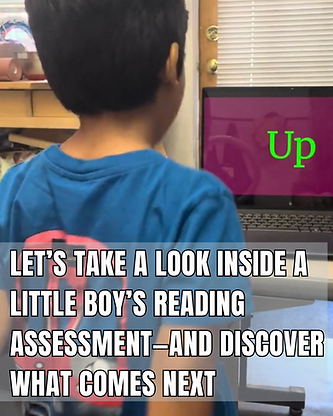
Follow R’s reading journey to see how an assessment can uncover the skills a child is ready to build next—and what Reading Accelerator looks like in action.
R can successfully read many familiar words.
He has developed a strong early foundation, and he enjoys reading.
So, what should he learn next?
This is exactly the kind of question a good reading evaluation should help us answer.
Because when we look at a child's reading development, we don't just want to know:
“Can they read?”
We want to know:
“What can they do independently—and what are they ready to learn next?”
For R, the answer was clear.
His next opportunity isn't simply to read more words.
It's to become a stronger thinker about what he reads.
Reading Is More Than Reading the Words
As children develop as readers, the skills they need change.
For younger children, this may mean building the foundations of reading:
Recognizing letters
Learning letter sounds
Hearing and manipulating sounds in words
Blending sounds
Decoding words
Building early word recognition
As children become more confident readers, the focus increasingly shifts toward understanding what they read.
Can they remember what happened?
Can they tell you what the story was about?
Can they identify the details that matter?
Can they put events in the correct order?
Can they answer a question and explain how they know?
These skills matter because reading isn't simply about getting the words right.
Reading becomes learning when a child can understand, remember, organize, and communicate the information they have read.
And that is the next step we identified for R.
What R's Reading Evaluation Showed Us
R can already read many familiar words successfully.
That's an important strength.
But our evaluation also helped us see where we can build from that foundation.
We want to give R a toolbox of strategies he can use when the word, story, or question is unfamiliar.
His primary instructional focus is:
Reading With Understanding
We want to help R learn how to:
Decide which details matter most
Identify the main idea
Retell events in a logical sequence
Make simple inferences using clues from the story
Explain how he knows an answer
Break unfamiliar words into smaller, manageable parts
The goal isn't simply for R to read more words.
The goal is for him to understand, organize, and communicate what he reads.
Why We Recommend Reading Accelerator
Based on R's evaluation, Reading Accelerator is his recommended next step.
His strong early reading skills give us an opportunity to build the higher-level comprehension skills that will become increasingly important as his books—and the demands of school—become more complex.
But Reading Accelerator isn't only for children at R's stage.
For a younger child, the next learning opportunity might be letter sounds, phonological awareness, blending, and early decoding.
For another child, it may be fluency, vocabulary, comprehension, recall, or verbalizing their thinking.
That's the purpose of the evaluation.
We don't start with a program and fit the child into it. We start with the child and identify what they need next.
What R Will Build in Reading Accelerator
For R, we would focus on three key areas.
1. Read With Understanding
Finding important details, identifying the main idea, understanding sequence, and recognizing meaning.
2. Explain His Thinking
Answering who, what, where, why, and how questions—and learning to explain how he knows.
3. Build an Independent Reading Toolbox
Using sounds, word parts, context clues, and reading strategies when something is unfamiliar.
These are the skills that help a child move from simply reading a story to actually learning from it.
What Makes Reading Accelerator Different?
At Compass we aren't simply giving R books to read and asking him comprehension questions.
We teach the thinking behind reading.
Our process is:
ASSESS → TEACH → PRACTICE → MEASURE → ADVANCE
We break larger reading skills into teachable steps, provide the support R needs to be successful, and gradually reduce that support as he becomes more independent.
As his skills grow, we increase the complexity of the stories, questions, vocabulary, and thinking expected from him.
This means instruction continually meets R where he is now while moving him toward what he is ready to learn next.
What Will Progress Look Like?
For R, we want to see him become increasingly able to:
Retell a story from beginning to end
Identify the most important information
Recall what he has read
Answer comprehension questions with less prompting
Explain how he knows an answer
Approach unfamiliar words using a strategy
Stay engaged as stories and questions become more complex
And these skills don't only support reading.
They contribute to writing, classroom discussion, storytelling, problem solving, learning new information, and communicating ideas clearly.
That's why comprehension matters so much.
And We Measure the Progress
One of the most important parts of Reading Accelerator is that progress doesn't have to be a guess.
Future Reading Accelerator snapshots can show R moving from:
BUILDING FOUNDATIONS → GROWING SKILLS → INDEPENDENT SKILLS
This allows parents to see not only what their child is learning, but how independently they can use those skills.
Because our goal isn't simply to teach a skill.
It's to help the child own the skill.
Why Now?
R already has something incredibly valuable: a strong early reading foundation and a love of reading.
That gives us an opportunity.
Rather than waiting until the books become significantly harder or comprehension becomes a struggle, we can build these skills now—while his reading confidence is growing.
We can teach him how to approach an unfamiliar word.
How to find the important information.
How to remember what he has read.
How to explain his answer.
And, most importantly, how to think about what he reads.
R doesn't just need more books.
He needs the right strategies for the next stage of his reading journey.
And that's exactly what his evaluation helped us identify.
From “Can he read?” to “What can he understand?”
Every child has a next learning opportunity.
For some children, it may be learning their letter sounds.
For others, it may be decoding their first words.
For children like R, it may be taking the next step from reading the words to understanding, recalling, and verbalizing what those words mean.
Reading Accelerator is designed to meet children ages 3–10 at that exact point—and help them take the next step forward.
Are you ready to discover your child's next learning opportunity?
Explore our Reading Accelerator Classes at Compass, and give your child the tools to become a confident, independent reader and thinker. Book your evaluation here or learn more about the program.
Best,
Jordanna

Comments